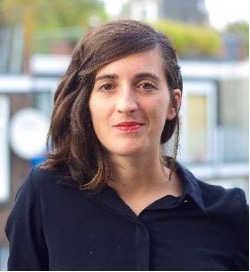
CLÉMENTINE COTTINEAU-MUGADZA
I am a geographer and an assistant professor of Urban Studies at TU Delft, NL.
My central interest in academic research is the evolution and causal relationships between economic segregation and economic inequality in cities. I study these relationship using quantitative microdata and simulation models, but I also have a strong interest in systematic literature reviews and automated mapping. See some example of this ongoing research: (Cottineau, 2025; Cottineau-Mugadza et al., 2024; 2026; San Millán et al., 2025).
I studied economic and geography in Paris, France, and defended my PhD from University Paris 1 Panthéon-Sorbonne in 2014. In my dissertation, I analysed and modelled the evolution of urbanisation in the post-Soviet space. During previous positions at UCL’s Centre for Advanced Spatial Analysis and CNRS’s Centre Maurice Halbwachs, I worked on the patterns and regularities of urban scaling, industrial geographies and the history of urban models. In particular, I collaborated with physicists, computer scientists and planners on the analysis of what changes in cities when the population size increases (e.g. urban scaling), but also how does this assessment depends strongly on how we define cities, how we delineate centres and peripheries. I showed that conclusions can be reversed on crucial topics like energy efficiency: large city centres become more efficient with size BUT larger metropolises are less energy efficient (per capita) than smaller cities when functional peripheries are included in the computation (Cottineau et al., 2017).
With graduation projects, I like to learn about new topics and pair up with design-oriented mentors. That way I can support students with their research and analytical methods.
Please, take a look at my profile at (https://clementinecttn.github.io) to get an overview of my current project and recent publications.
Cottineau, C., Hatna, E., Arcaute, E., & Batty, M. (2017). Diverse cities or the systematic paradox of urban scaling laws. Computers, Environment and Urban Systems, 63, 80–94. https://doi.org/10.1016/j.compenvurbsys.2016.04.006
Cottineau-Mugadza, C. (2025b). Economic inequality and economic segregation: A systematic review of causal pathways. Social Forces, soaf195. https://doi.org/10.1093/sf/soaf195
Cottineau-Mugadza, C., B., Benenson, I., Delloye, J., Hatna, E., Pumain, D., Sarkar, S., Tannier, C., & Ubarevičienė, R. (2024). The role of analytical models and their circulation in urban studies and policy. Urban Studies, 61(12). https://doi.org/10.1177/00420980241237410
Cottineau-Mugadza, C., Perret, J., Reuillon, R., Rey-Coyrehourcq, S., & Vallée, J. (2026). An agent-based model to investigate the effects of urban segregation around the clock on inequalities in health behaviour. EPJ Data Science, 15(5). https://doi.org/10.1140/epjds/s13688-025-00603-4
San Millán, J., Cottineau-Mugadza, C., & Van Ham, M. (2025a). From flux to capital: Distinguishing patterns of income and wealth segregation in the netherlands. Population, Space and Place, 31(8), e70127.

